


Presentations play a strong role in translating health research into language and visuals take resonate with nonexperts. Change occurs one conversation at a time, and when you can speak with multiple stakeholders at once, that’s when movement on an issue really happens.
Outside the academy, presentations may be formal or informal, delivered in range of venues. You may be asked to “present” in a board room, and auditorium, a coffee shop, or a corner of the production floor.
Consequently, flexibility is the name of the game. Although it may seem efficient to create a “standard” presentation you can reuse in different contexts, success comes to those presenters who can adapt.
It also comes to those who understand the presentation not just as a tool for imparting information but as the means to spark discussion. In many situations, your most important goal as a presenter will be to engage your audience so they will open up to you, share their goals, and explore ways to join you in your mission.
Presentations that spark conversations
How thinking like a teacher can damage KT presentations
As a health researcher, you may have various kinds of teaching experience, from lecturing undergrads to delivering conference presentations to training colleagues. In some ways, thinking like a teacher can help with knowledge translation. When it comes to presentations, however, some of the tactics familiar from your teaching experience can backfire.
Here's the key question to ask yourself: Does this presentation mainly need to inform the audience, or does it need to persuade them?
Many teaching presentations focus on delivering information. For example, if you're teaching university students about the four areas of specialization within bioengineering, then you might create a slide that looks like this:
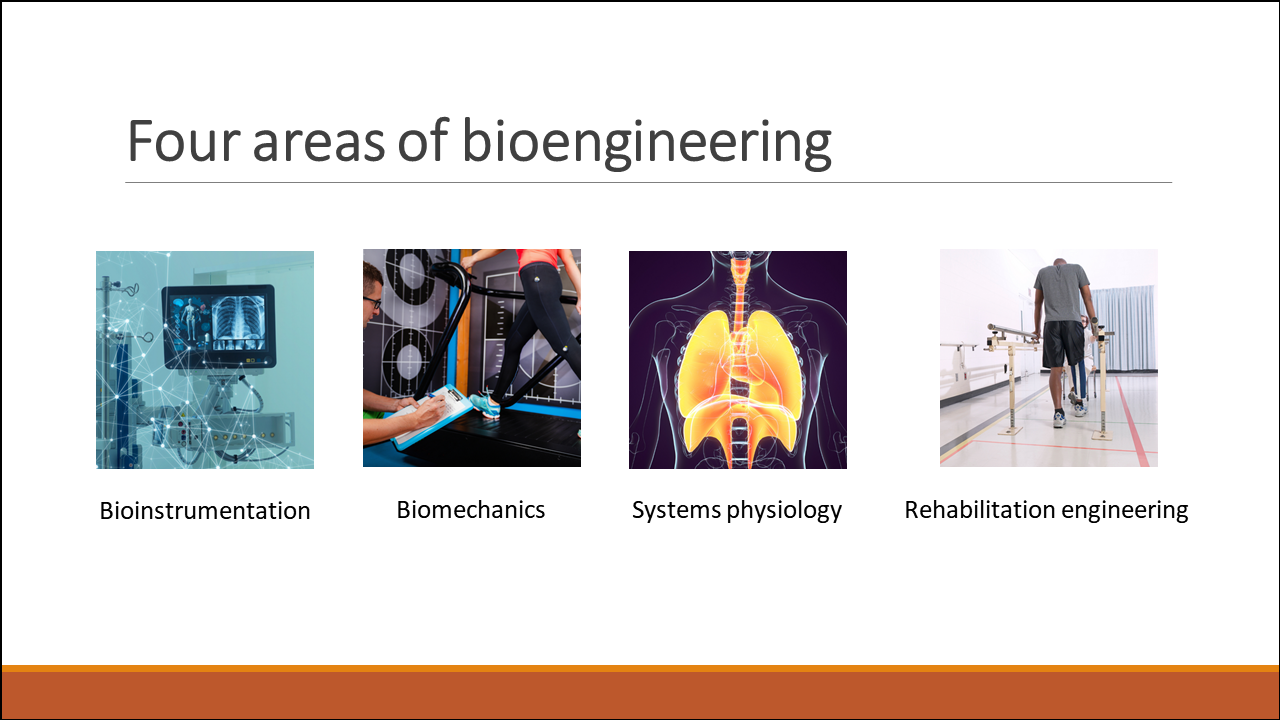
Such a slide describes a topic, but it doesn't take a position on it. The goal is to help the audience gain knowledge, not develop an opinion on it or take action.
In many KT situations, however, your goal is to shape opinion and influence action. Imagine, for instance, that, as a professor of bioengineering, you've been asked to deliver a presentation to the government department that funds post-secondary education in your province. Your goal is to persuade department officials to increase the amount they've been investing in bioengineering degree programs.
In this case, it's not enough to simply inform your audience what bioengineering is and what specialty areas it includes. You must make--and carry--a point. To that end, you'll need to revise your slide so that it takes a position. This will require you to make two changes to your original slide:
- Convert the topic headline to a statement (or what engineering professor Michael Alley calls an "assertion" headline)
- Show how each visual on the slide supports or develops the headline
Here's what a revised, persuasive slide might look like:
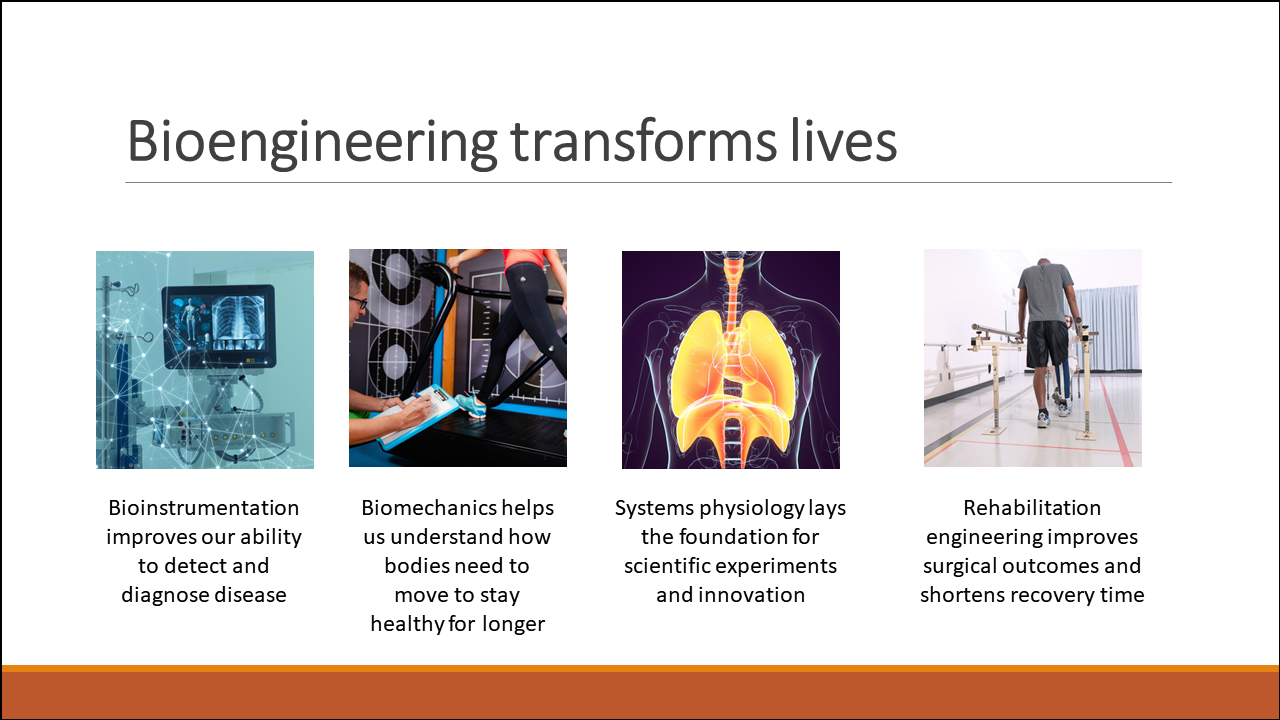
Whenever you want to (a) make a logical argument, and (b) convince your audience to adopt your position, then your slides should make clear, well-supported statements. Professor Michael Alley calls this approach the "assertion-evidence" method, and following it will dramatically change the way you build your slide decks, the way you deliver presentations, and maybe even the way you teach.
Introduction to Michael Alley's method
Michael Alley describes his method as suitable for “research talks,” such as conferences. However, it also works well for situations outside of academia, with a few qualifications:
- Make sure that your headlines resonate with your Impact Audience. Use simple, clear language that engages your audience emotionally.
- Use the headlines to take your audience on a journey of persuasion. Enable them to grasp the problem your research addresses and envision the positive difference it could make.
- Use simple, emotionally resonant visuals that draw the audience into the presentation. (Avoid complex visuals that make them squint and scratch their head.(N)
- Leverage the power of storytelling. Show the human impact of your research through dramatic examples that people can relate to on an emotional level.
Check out these links, and you'll master the “assertion-evidence” approach in no time:
- A PowerPoint trick you wish you knew before (overview of Alley’s method)
- Tutorial by Michael Alley (26 minutes)

Avoid these design flaws in your slides
Many presentations fail to deliver results because their visuals confuse the audience. Take note of these common pitfalls so you can avoid them!
Curated Resources
Two thinkers whose work complements Alley's are Nancy Duarte and Garr Reynolds.
Duarte's work is most relevant for pitches, presentations that aim to persuade the audience to buy in to a new idea. She does a great job of explaining how to put the audience at the center of your persuasion journey. (The audience should be the hero of the story, not you or your research.)
Reynolds challenges the paradigm of dense, data-driven slides in favor of imagistic, emotionally-resonant designs. His classic Presentation Zen will change your perception of how PowerPoint can enrich your ability to engage with a live audience.
- Resonate by Nancy Duarte (free multimedia version of her book)
- Why storytelling matters (TedX talk by Garr Reynolds, author of Presentation Zen)
- 11 ways to use images poorly in slides (Reynolds)
- Five ways to reduce PowerPoint overload (PDF)
- TED's secret to great public speaking (by the curator of TED talks, Chris Anderson)
- How to speak so that people want to listen (TED talk by Julian Treasure)
Downloadable tools
- Assertion-evidence templates provided by Michael Alley (Note: for a nonexpert audience, you may want to simplify, and modernize, some of the layouts.)
- Canva offers many free presentation templates that you can use as models for PowerPoint or Keynote presentations.
- Visual Design Checklist
Try this!
Imagine you have the opportunity to pitch an influential policy-maker or industry leader on implementing some aspect of your research. Develop a 10-slide presentation deck that will persuade them to work with you and turn your research into action.
 Please log in or register to post a comment