

KT Project Guidelines

Through your KT project, you'll develop a communication product to share some aspect of your current research with an Impact Audience (a specific community you want to influence) outside your scholarly peer group.
There is no set length, but the product you create should be substantial enough to achieve its communication goals. For example, you might create a blog article, a three-minute slide presentation, a three-minute video, or a script for a podcast episode.
Use your ingenuity to choose a form that will appeal to your Impact Audience. Leverage your strengths while stretching outside the comfort zone of producing academic articles.
Your project should NOT merely explain a topic. It should persuade the audience to adopt your point of view on the topic and/or take a particular action.
For instance, let's say you're researching the relationship between climate change and public health and are studying the greenhouse gas (GHG) emissions caused by food that decomposes in garbage dumps. Your KT project shouldn't simply explain how the food produces GHG or document the seriousness of the problem. It should target a specific audience and convince them to help solve the problem. For example, you might target a municipal council with the goal of persuading them to pilot a compost pick-up program for city residents.
Project presentations
On February 9-10, we'll meet (virtually) in small groups so you can present your KT project and get feedback on it.
You'll need to register in advance for one of the groups:
- Feb 9, 10:00-11:30 a.m. Register here.
- Feb 9, 1:00-2:30 p.m. Register here.
- Feb 10, 1:00-2:30 p.m. Register here.
Presentation expectations
To make sure everyone has time to present, we will stick closely to the three-minute limit for each presentation. On Zoom, you'll see me hold up a sign when you have 30 seconds left and another sign when you have 10 seconds left.
During your presentation, please tell us:
- Your target audience.
- Your goal for your communication product. (Try to narrow this to the next step you want your audience to take after interacting with your communication product.)
- Why you chose the form you chose (e.g., report, video, infographic).
- Your key message and how you've conveyed it.
- Outstanding questions you have. This is your opportunity to get feedback on aspects of your work that you'd like to improve.
As you prepare your communication product, keep an eye on the assessment criteria in the KT Communication Scorecard. I'll use this tool as part of the written feedback you'll receive following your presentation. (You can download a copy below.)
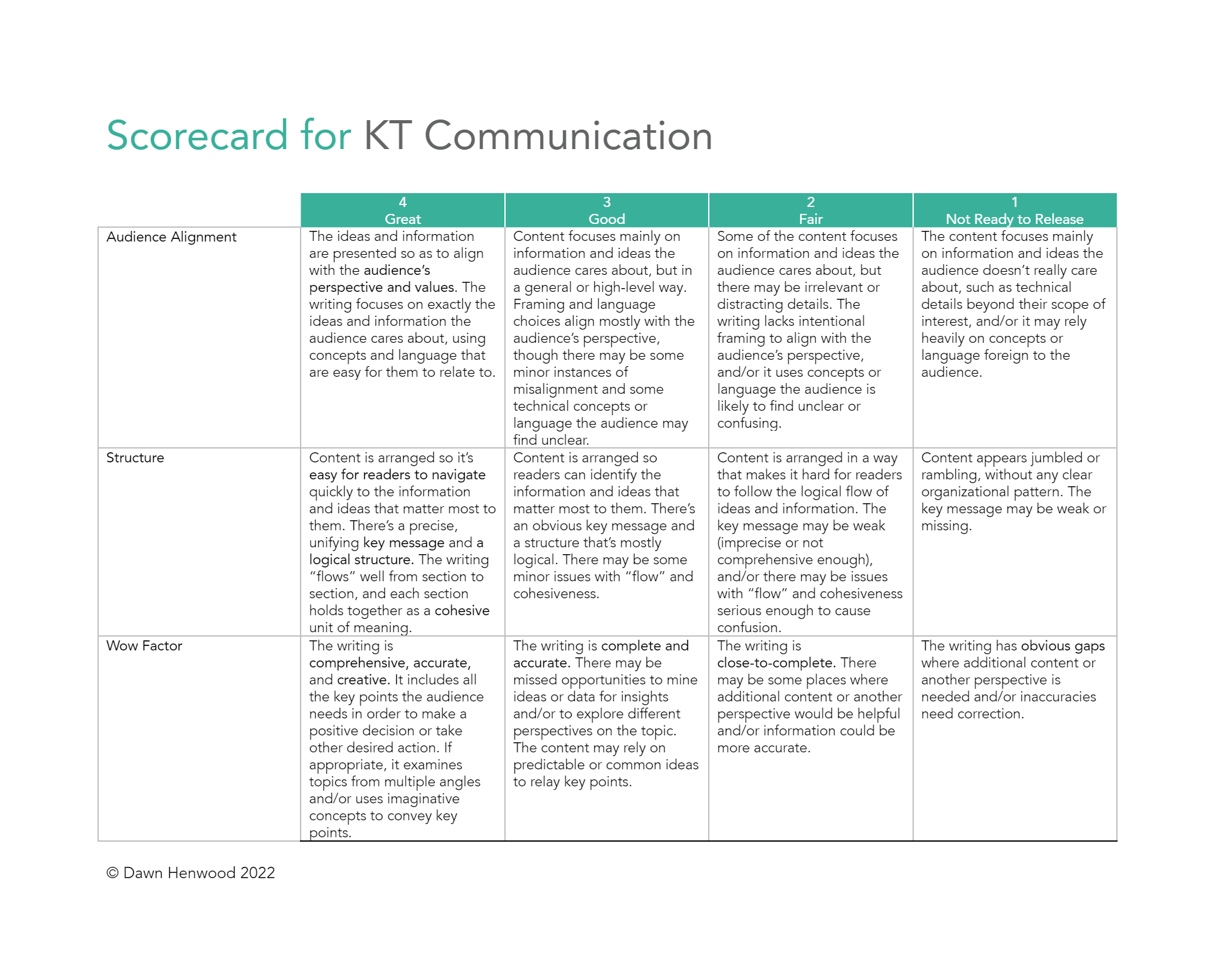
Feedback on your project
Following your presentation on February 9 or 10, you'll receive detailed written feedback by email. The assessment should arrive in your inbox by the end of February.
 Please log in or register to post a comment